Showing posts with label DCFS. Show all posts

Thursday, May 14, 2015

The Use of Professionalism in Contacting DCFS Caseworkers by Robert Copier

In light of our recent post on Can Parental Defense Attorneys Communicate with DCFS Caseworkers? and the Ethics session at the Annual Conference, we have asked Robert Copier to give us his perspective on the subject.

_________________________________________________________

The Parental Defense Alliance has asked me to share my thoughts about the part of an ethics presentation at the recent excellent Annual Conference that focused on the "hot issue" of contact between parental defense lawyers and DCFS caseworkers without an Assistant Attorney General present.  As Utah offers ethics advisory opinions, my first move was to request one.  See letter dated May 1, 2015, Scenario Three.

Beyond that, based on my four-decade career in auditing and law that started in 1975 during which I worked with and against, supervised, and audited some of the finest lawyers in the Utah State Bar, my take is that this "hot issue" actually falls within my maxim that in the living of life, 90% of problems are solved by money and the other 10% are solved by death, while in the practice of law, 90% of problems are solved by professionalism and the other 10% are solved by death.  Allow me to expand that thought.  At the outset of any new litigation matter, the best thing a lawyer can do is sit down face-to-face with opposing counsel and offer to try to get as much accomplished between professionals as possible so that judicial decision and intervention will be needed as little as possible.

Under such an approach, one can ascertain whether the Assistant AG prefers that the lawyer not contact the DCFS caseworker directly without the Assistant AG present.  If that is the Assistant AG's wish, honor it, but ask the Assistant AG to reciprocate by being reasonably available.  You can't control whether the Assistant AG honors your request, but you can stay professional by honoring the Assistant AG's request.  And any short-term inconveniences you face can usually be solved in the long-term, not only in child welfare cases, but in almost all juvenile, civil, probate, and criminal cases, since, except in a Capital Murder Case where the sentence of death has already been carried-out, you are usually not without litigation moves.

Indeed, even the "mandatory" tight deadlines in child welfare juvenile court cases yield to professionalism in which the lawyers can take control of the case in a professional manner and leave as little to judicial decision and intervention as possible. [D.H. v. State, 2014 UT 26, n. 4].   Parental defense lawyers should build on that helpful appeal decision and take control professionally.

It is amazing what professionalism can accomplish.  In my own situation, auditing and law were a second career after retiring from an earlier career and I was professionally positioned to be able to take long absences living abroad and other sojourns and sabbaticals away from the law and then returning to my litigation caseload and working on it in "concentrated streaks."  One would think this to be impossible, as opposing counsel would take advantage of those sojourns away from practice by actual or de facto defaults against me.  But anything like that can be cured after- the-fact through professionalism between counsel.  In my situation, that has consistently occurred through professionalism or will so occur [although a handful of opposing lawyers don't realize that yet].  Stay professional.  If an opposing Assistant AG doesn't want you to contact DCFS workers, then don't.  But, since you can ask anyone anything if you do it in a nice way, ask him or her to reciprocate by being reasonably available.  They may so reciprocate or they may not.  But you can control only your own professionalism, regardless of whether they reciprocate or not.

Happy to entertain any questions and give non-legal advice upon request at no charge to any PDA member or parental defense lawyer facing these situations.  Telephone (801) 272-2222.

Robert Henry Copier, 727

COPYRIGHT 2015 - ROBERT HENRY COPIER

Monday, February 2, 2015

Law Review Article: Can the Child Welfare System Protect Children Without Believing What They Say?


A new Law Review Article by Tara Urs was recently published by Seattle University on how suggestibility and lie-telling behavior in children impact child welfare investigations and cases.  It's called Can the Child Welfare System Protect Children Without Believing What They Say?  You can get the full article HERE.

Abstract: In Kennedy v. Louisiana, the Supreme Court noted that the problem of “unreliable, induced, and even imagined child testimony” creates a “special risk of wrongful execution in some child rape cases.” Indeed, empirical research has repeatedly demonstrated problems with accuracy in children’s accounts of their own experiences. Although the research and commentary in this area has focused on how allegations of child sexual abuse are addressed in the criminal justice system, these studies have much broader implications: every year, state officials conduct millions of interviews with children in the context of child welfare investigations. These investigations have serious consequences for families — for instance, they can lead to the placement of a child in foster care or the termination of parental rights. This article examines the reliability of child welfare determinations by looking at a subset of the information investigators consider: children’s statements about their past experiences. First, this article reviews empirical research on suggestibility, lie-telling behavior, and the capacity of adults to detect lies in children. The article then examines the impact of structural features in the child welfare system, and posits that these structural features do not facilitate the proper evaluation of child statements. The article concludes by proposing legal reforms to improve the reliability of child welfare determinations. Ultimately, this article aims to defend the proposition that caring deeply about children and their safety does not necessarily mean the child welfare system should rely on what children say.

Monday, January 5, 2015

Can Parental Defense Attorneys Communicate with DCFS Caseworkers?


At our Judge’s Panel Luncheon, a question came up regarding whether a parent attorney could attend a child and family team meeting or otherwise communicate with a DCFS caseworker without the presence of an AAG.  The following advisory opinion offers the answer.

Utah Rules of Judicial Administration Chapter 13 Rule 4.2 prohibits contact of represented persons by attorneys unless authorized by law, rule, or court order.

In 1993, the  advisory committee was asked in regards to the application of this rule in the context of agency employees and the Attorney General’s office.

The office provided the following opinion:

A lawyer representing a government department may not prevent his non-government counterpart from contacting any employee of the government office or department outside his/her presence, whether or not the communication involves a matter in litigation. However, if counsel for a private party contacts a government employee about pending litigation, counsel must inform the government employee (a) about the pending litigation or that the matter has been referred to agency counsel and (b) about his representation of a private party in that litigation.
Utah Ethics Adv. Op. No. 115 (1993).

This opinion was reaffirmed in July 1994 by Utah Ethic Adv.Op.No. 115R (1994).

In short, yes, a parental defense attorney can speak with the caseworker regarding the case--and even attend a family group meeting--without the AAG being present and without the AAG's permission, if the attorney discloses to the worker the existence of the litigation and discloses who the attorney represents.

Tuesday, October 28, 2014

Model Family Foster Home Licensing Standards


The following is a press release from the ABA:
The American Bar Association (ABA) Center on Children and the Law, the Annie E. Casey Foundation, Generations United and the National Association for Regulatory Administration (NARA) are thrilled to announce the release of Model Family Foster Home Licensing Standards.
 Our partnership has been working for several years on these comprehensive pre-placement licensing standards that, for the first time, help ensure children in foster care are safe while also establishing a reasonable, common-sense pathway to enable more relatives and non-related caregivers to become licensed foster parents.
While we acknowledge that not all states will be able to implement this model in its entirety without any modifications, we challenge all states to use the Model to assess and align their own standards.
  
The package of materials includes:
  • Purpose statement
  • 10 guiding principles
  • The Model Standards
  • An Interpretative Guide, which summarizes the purpose of each standard and  provides instructions for compliance determinations
  • A crosswalk tool, which is designed to assist states and counties in comparing and aligning their current standards with the Model      
We are committed to assisting states and counties in implementing this Model.  Attorneys at Generations United and the ABA Center on Children and the Law are available to provide technical assistance to jurisdictions seeking to align their current rules, policies and practices with the Model Family Foster Home Licensing Standards.  This technical assistance is available free of charge thanks to support from the Annie E. Casey Foundation.  Contact Ana Beltran at abeltran@gu.org  or Heidi Redlich Epstein at Heidi.Epstein@americanbar.org .   Licensing experts are also available through NARA to provide agencies with in-depth consulting services.  www.naralicensing.org  
The standards are posted on www.grandfamilies.org or are available HERE.

Monday, October 13, 2014

DCFS Responds to the Supreme Court's Denial of Cert. in the Same-Sex Marriage Cases


On Monday, October 6, 2014, the Supreme Court of the United States denied all seven petitions that arose from challenges to various state bans on same-sex marriage, including that belonging to Utah.

Brent Platt, the director of the Division of Child and Family Services, sent out the following guidance to case workers regarding how the division would respond to the court decision:

As promised, this is a follow up to offer guidance regarding Monday's Supreme Court decision as it relates to our work at DCFS.
1.  DCFS recognizes all legally married couples and individuals who meet the Licensing and DCFS criteria for preliminary, kinship, foster care, and adoptive placements.
2.  When placement decisions are being made, we must always consider what's in the best interest of the child(ren).
3.  In order to comply with the Supreme Court decision and Governor Gary R. Herbert's directive, we will be updating Practice Guidelines immediately.
Please direct any questions to our State Office Program Administrators:
Foster Care - Tanya Albornoz, 801-646-4866
Adoption - Marty Shannon, 801-540-0833
Thank you for your hard work and commitment to Utah's children and families. 


Friday, September 5, 2014

Identifying Bias in Caseworker Assessments

Linda Wininger of DCFS presented a short Ignite talk at the Court Improvement Summit on the implementation of the Structured Decision Making (SDM) Program recently adopted by DCFS.  You can find a full set of the slides she used HERE.

One of the effects of SDM is that decisions will be more uniform as workers adhere to the SDM practices.  The goal of SDM is to have similar outcomes among cases with similar facts, but with different CPS workers.

There are a number of factors that a case worker considers when determining whether children should be removed from a home.  Some of these factors influence the case outcome even if they are unrelated to the case.

The first set of factors described by Ms. Wininger were Case Factors.  These include the type of maltreatment experienced by the child, whether there is a pattern of maltreatment, the risk of continued harm, the safety of the child, as well as, the specific characteristics of the child and the family.


The next set of factors that can impact a case is Organization Factors.  These factors are centered on DCFS administration: the resources available, the size of the caseload of the worker, the support a caseworker might get from a supervisor or from a work team, the Policy and Practice expectations, as well as, Bureaucratic distractions.


The third set of factors that can influence decision making and thus outcomes are centered on the person making the decision, a.k.a. the caseworker.  These are Decision Maker Factors and can include past experiences, skills, values, how comfortable they are with casework and their predilection towards protection children or preserving families. 


The final set of factors that affect the outcomes of cases are External Factors.  These can be the law and the courts, perhaps even the judge, the engagement of the community, the resources available, as well as, critical events and funding.


In deciding whether to remove a child from the home, the caseworker will complete the SDM Assessments.  An Assessment will fall somewhere on the spectrum between a high and a low level of concern.


In addition to the Assessment, each caseworker will have a Threshold of what they think is appropriate or what they can tolerate in a given situation.  This Threshold will also fall on the spectrum between a low and a high level of concern.


If the Assessment indicates a higher level of concern than a caseworker’s threshold, then the child will be removed.  If the Assessment is below the caseworker’s level of concern then removal will not take place.  Differences in outcomes can result when caseworkers have different thresholds.


It is important to recognize which factors influence the Assessment and which influence the Threshold.  Only the Case Factors will influence the Assessment.  All other factors—the Organization Factors, the Decision Maker Factors, and the External Factors—affect the Threshold.  Even when the Case Factors are identical and result in identical Assessments, the factors influencing a caseworkers threshold can produce different outcomes.


Ms. Wininger acknowledged that workers don’t share the same values and depending on personal biases, in cases that are factually similar, one worker might remove when another might not.  It is important to acknowledge and consider the biases that might affect case outcomes.

MsWininger spoke to the attendants at the conference which included DCFS workers and encouraged them before making a final decision on removal to consider what factors are affecting their decision and consider alternative perspectives on the facts.

Wednesday, September 3, 2014

Should DCFS Workers be profiled?


Given the stress, burnout and turnover of Child Protective Services ("CPS") workers across the country, Daniel Pollack of Yeshiva University and Khaya Eisenberg have posited that using profiling in the hiring of CPS workers may help reduce these problems.  Their article The Need for a Child Protective Services Investigator Psychological Profile was recently published in the Michigan Child Welfare Law Journal.  In the article they use law enforcement hiring practices as an analogy and consider the personality traits of an ideal CPS worker.

What do you think?  Should CPS workers be profiled?

Have You Seen A Risk ReAssessment?

Most of you are probably familiar with the Structured Decision Making ("SDM") Safety and Risk Assessments that DCFS is using to determine whether to remove kids from their home.  (If you aren't you can take the training HERE.)

What about the Risk ReAssessment?  Have you seen one of these in your cases?  No?  There may be a reason.

At the Court Improvement Summit Linda Wininger from DCFS shared the following slide that shows the number of SDM Assessments completed by caseworkers as of August 5, 2014.
See the difference?  Very few Risk ReAssessments have been completed compared to the Safety and Risk Assessments.  I was curious about why this might be the case and so contacted Ms. Wininger.  Here is what I found out.

Ms. Wininger let me know that DCFS was also wondering about the discrepancy in numbers.  They plan on additional follow up to determine the low number, but the have some idea why it may be.

1.  The Risk ReAssessment is only used in In Home cases.  There are significantly more CPS/removal cases than In Home cases.
2.  The Safety and Risk Assessments can be done in any type of case.
3.  The Safety and Risk Assessments are required before a CPS case can be closed.  While the Risk ReAssessment is required by DCFS policy, it is not required by the SAFE System.

Ms. Wininger also let me know that the Risk ReAssessment was intended to be completed at least every 6 month usually to correspond with an update to the Child and Family Plan or a court review hearing or progress summary.  It can be completed sooner if there are new circumstances or new information that would affect the risk factors.  The Risk ReAssessment can set a new risk level and change the contact standards.  A parent's attorney could certainly ask for one to be done and discuss it at a Child and Family Team meeting.

So if you haven't see a Risk ReAssessment in you In Home cases and you think it would be appropriate and helpful, ask for one to be completed.

Thursday, August 28, 2014

Do You Have The Structured Decision Making Manual?


Good news!  DCFS has provided the PDA with a digital copy of the Structured Decision Making ("SDM") manual.  They have allowed us to share this with our members for FREE!  The only catch?  You have to take the Structured Decision Making training before we can send you the copy.

Since we want this manual in the hands of every parental defender in the state we are offering the online SDM training for FREE with this code:  SDMMANUAL.  The code will be good until the end of September.  You will get three hours of self-study CLE and will be able to watch it at your convenience.  Use the link below.


Once you complete the training (Don't forget to enter the codes that show up in the video) just email me for a copy of your manual.  For those of you who have already taking the training and would like a copy, just email me!  kate@parentaldefense.org


Wednesday, July 23, 2014

Where to report complaints about DCFS


According to the Child Welfare Ombudsman Annual Report: 

In January 1996, the Executive Director of the Department of Human Services created the Utah Office of Child Protection Ombudsman, independent from Child and Family Services, where the public could report concerns about cases under Child and Family Services' jurisdiction.  In 1998, the Utah Legislature codified the role and authority of the Ombudsman's Office by enacting Section 62A-4a-209 of Utah Code, which states:
"...the ombudsman shall, upon receipt of a complain from any person, investigate whether an act or omission of the division with respect to a particular child: (i) is contrary to statute, rule, or policy; (ii) places a child's health or safety at risk; (iii) is made without an adequate statement of reason; or (iv) is based on irrelevant, immaterial, or erroneous grounds..."
The purpose of the Ombudsman's Office is to receive and investigate complaints, provide a voice to the consumer/complainant, promote a way whereby concerns or disputes are addressed at the lowest level possible, and ensure that Child and Family Services is providing adequate services to their clients.  Currently, the Ombudsman's Office is the only independent office in State government where complainants can express their concerns about child welfare cases.  For this reason the Ombudsman's Office is a unique resource to Utah's citizens.

The website for the Ombudsman is: http://ocpo.utah.gov/

Wednesday, June 18, 2014

Time to Register for the Court Improvement Summit


The time has come to register for the 2014 Court Improvement Summit.

The 2014 Summit is Thursday and Friday, August 14th and 15th at the Salt Lake City Radisson. The theme of this year's Summit is The Fabric of Family: Reexamining the Role of Family Connections in Child Welfare.  You can download the Agenda HERE.

This conference is a great opportunity to hear nationally renowned, as well as, local speakers on the topic of family connections in Child Welfare.  Invited to attend are DCFS workers, AGs, GALs, Parental Defenders, Judges and other stakeholders in Utah's Child Welfare System.

The Parental Defense Alliance has been allotted 50 spaces at the conference.  If you are interested in attending please email me at kate@parentaldefense.org and I will get you the registration link.  Preference will be given to those attorneys with county contracts including conflict contracts.  I will keep a list of private attorneys interested in attending until any public defenders have been given the chance to register.

Cost
FREE.  I believe CLE credit will be available.

Lodging
Lodging on Wednesday night is available to those who work at least 50 miles from the Radisson.  Lodging on Thursday night is available to ALL regardless of distance. We want you to stay.  Lodging is complimentary. You can indicate that you need lodging on the registration form. By doing so your name will be added to a rooming list. Please do no contact the hotel to reserve lodging.

Travel
Due to parking limitations, participants are encouraged to carpool. Mileage reimbursement will be provided to those who do not have access to employer vehicles.

Wednesday, May 7, 2014

New from DCFS: HomeWorks

Over the next few years, Utah's DCFS is rolling out a new evidence-based in-home services program called HomeWorks.  If you are in Clearfield, Bountiful or Brigham City, efforts are already underway to implement the program.  The Southwest region of Utah will see the program begin in November 2014.  Salt Lake, the Western and Eastern Regions will be in 2015 through 2016.  

The flyer below sets forth the details of the program.  You can also download a copy HERE.  If you have questions you can contact Kevin Jackson at kevinjackson@utah.gov.


Monday, April 28, 2014

How DCFS Makes Removal Decisions


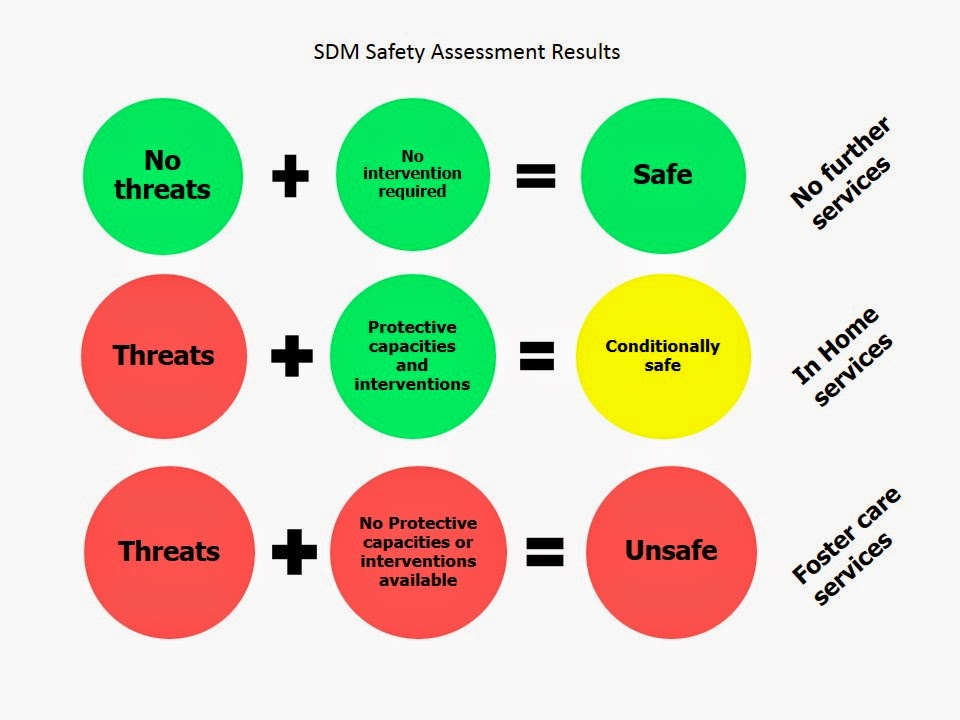
Last week I attended a Court Improvement Program meeting whereat the DCFS gave an update on the implementation of the Structured Decision Making (SDM) Program.  There are 5 assessments that the SDM Programs covers:

  • Intake Assessment.  This assessment has not yet been implemented because the referral system is being overhauled to become web-based.
  • Safety Assessment.  This assessment is made at the time a case worker first encounters a family.  It is essentially a decision regarding whether a child can remain at home or needs to be removed.  You can see above a diagram of the three categories families will fall into.  For those who are safe, no services are needed, for those who are conditionally safe in home services are appropriate, for those who are unsafe foster care services are necessary.
  • Risk Assessment.  This is an assessment to determine whether services can continue.  The chart below shows how the safety and risk assessments work together.  
  • Risk Reassessment.  This assessment is a continuation of the Risk Assessment and made sometime after the initial risk assessment.
  • Reunification Assessment.  This assessment has not yet be implemented.

The Safety Assessment, Risk Assessment and Risk Reassessment have all been implemented statewide as of December 2012.  DCFS is continuing to work on fidelity to the model with their case workers.  The SDM Program has been successfully implemented in other jurisdictions and has resulted in lower removal rates and allowed states to focus their services on the families who really need them.  The goal is to have a removal rate in 4% of cases.  As of January 2014, Utah had a removal rate of 4.12%.

The SDM Program is good for parents and their attorneys because it provides the underlying reasoning of DCFS caseworkers decisions.  If you are not asking for the SDM assessments mentioned above in your cases we hope you will continue to push for them.

If you are interested in a CLE training on how the safety and risk assessments work, you can sign up for a 3 hour online training below.  It's $35.00 for 3 hours of CLE.  Use the discount code: annualconf for $10 off.


Tuesday, October 15, 2013

DCFS SDM Training


Last Friday, on October 11, 2013, the Parental Defense Alliance (PDA) held a free Lunch and CLE at the Utah Valley Convention Center in Provo, Utah.  The presenters were from the Division of Child and Family Services (DCFS) and instructed us regarding the new Structured Decision Making (SDM) process that they are implementing throughout the state.


The DCFS has been training their caseworkers regarding SDM, but the PDA is the first group to request and receive the training outside of the division.  Those who attended received helpful instruction regarding how the DCFS caseworkers will be making decisions regarding families and services.

One attendee let us know:
"Having a good understanding of SDM is extremely helpful to determine whether DCFS used correct criteria to remove children from custody of parents and whether children can be safely returned or maintained at home with ongoing services."

Another said:
"This training offered information absolutely necessary to understand the decision making process behind DCFS decisions to get involved in a family.  If the decision is to get involved, how intrusive the involvement will be and what considerations to decide when to get out of the case."
For those of you who missed the training, we are excited to let you know that we are working on providing a video recorded version on our website.