Wednesday, May 7, 2014

New from DCFS: HomeWorks

Over the next few years, Utah's DCFS is rolling out a new evidence-based in-home services program called HomeWorks.  If you are in Clearfield, Bountiful or Brigham City, efforts are already underway to implement the program.  The Southwest region of Utah will see the program begin in November 2014.  Salt Lake, the Western and Eastern Regions will be in 2015 through 2016.  

The flyer below sets forth the details of the program.  You can also download a copy HERE.  If you have questions you can contact Kevin Jackson at kevinjackson@utah.gov.


Monday, May 5, 2014

Spotlight: Justin Caplin

I'm Justin Caplin and practice in Utah County with Moody Brown Law doing family law and parental defense. I share a portion of a conflict contract here, primarily in American Fork and Orem juvenile courts.

I am a new attorney, been practicing for just under a year, and I really enjoy the parental defense work that I do.  With divorces I am helping to divide a family. With parental defense cases I feel like I am working with already severely broken families and trying to help them build and piece the family back together.

One case that I have enjoyed is with a father that had only seen his daughter a couple times in the past couple years.  After DCFS got involved, we've worked together to help him reestablish that relationship with her and begin to enjoy more frequent and regular parent time with his daughter.

Monday, April 28, 2014

How DCFS Makes Removal Decisions


Last week I attended a Court Improvement Program meeting whereat the DCFS gave an update on the implementation of the Structured Decision Making (SDM) Program.  There are 5 assessments that the SDM Programs covers:

  • Intake Assessment.  This assessment has not yet been implemented because the referral system is being overhauled to become web-based.
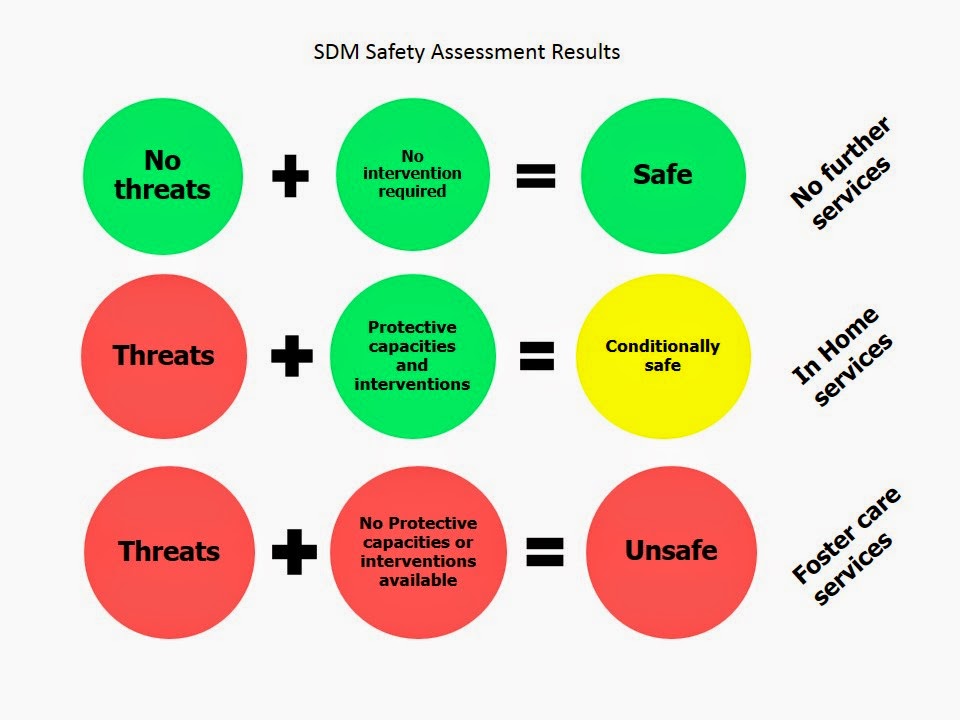
  • Safety Assessment.  This assessment is made at the time a case worker first encounters a family.  It is essentially a decision regarding whether a child can remain at home or needs to be removed.  You can see above a diagram of the three categories families will fall into.  For those who are safe, no services are needed, for those who are conditionally safe in home services are appropriate, for those who are unsafe foster care services are necessary.
  • Risk Assessment.  This is an assessment to determine whether services can continue.  The chart below shows how the safety and risk assessments work together.  
  • Risk Reassessment.  This assessment is a continuation of the Risk Assessment and made sometime after the initial risk assessment.
  • Reunification Assessment.  This assessment has not yet be implemented.

The Safety Assessment, Risk Assessment and Risk Reassessment have all been implemented statewide as of December 2012.  DCFS is continuing to work on fidelity to the model with their case workers.  The SDM Program has been successfully implemented in other jurisdictions and has resulted in lower removal rates and allowed states to focus their services on the families who really need them.  The goal is to have a removal rate in 4% of cases.  As of January 2014, Utah had a removal rate of 4.12%.

The SDM Program is good for parents and their attorneys because it provides the underlying reasoning of DCFS caseworkers decisions.  If you are not asking for the SDM assessments mentioned above in your cases we hope you will continue to push for them.

If you are interested in a CLE training on how the safety and risk assessments work, you can sign up for a 3 hour online training below.  It's $35.00 for 3 hours of CLE.  Use the discount code: annualconf for $10 off.


Spotlight: Jose Silva

My name is Jose Silva.  I am a fulltime parental defense attorney out of the Fourth District Juvenile Court in Orem Utah.  I am assigned to Judge Noonan's court room.  I have been involved with the juvenile courts for over thirteen years and have been full time with the Utah County Public Defender's Association as a Parental Defense attorney since 2009.

Over the many years working in the juvenile court I have not only learned to love the work but also have become very passionate about parental rights.  With so many judges marching to "save babies" its important to remember and fight for the God given and Constitutional rights of a parent to raise a child as they feel is best, that being the norm and the exception being State involvement.

My most visible case was HUBNER early in my career.  It involved a out of state non custodian father who the State repeatedly failed to locate and serve Notice of the State's involvement with his children.  Only until the mother's right were terminated did the State serve the father with Notice of his TPR trial. His rights were terminated and the Utah Court of Appeals reversed the TPR sighting 13+ due process violations by the State. Not many victories like that in this business.

However, I believe my most successful case was more recent when after shelter hearing and removal of the children, I was able to convince the State to return the children and dismiss their petition entirely, closing the case.  It is always better to cut State involvement at the earliest moment.

My advice to any attorney thinking of practicing in this field would be to negotiate, negotiate, negotiate. The less left up to the judges on your cases the better for your clients, generally.

Tuesday, April 22, 2014

What You Do Is Important

This is a wonderful video about the importance of legal representation for indigent parents in child welfare cases.  It even features Utah's Judge William A. Thorne of the Utah Court of Appeals.

Monday, April 21, 2014

Spotlight: Jordan Putnam

Name: Jordan Putnam

Firm: Lokken & Associates, P.C.

County Contract: Our office has the contract for Salt Lake County.

Something you love about being a parental defender: I enjoy being able to help parents who love their children and want to change their lives, but struggle due to mental health, substance abuse or issues. As their attorney, I am in a unique position to walk them through the process, while ensuring that their rights are safeguarded. Often times, I am the only person they will listen to. It's amazing to see how strong people are and how much they can overcome. It's very rewarding when a case is successfully closed and to witness the changes that occur within a person from the beginning to the end of a case.

A tip or trick: Communicate, communicate, communicate. Just as in every other area of the law, clients want to know what is going on with their case and that you (their attorney) are on top of it. Good client communication can be the difference between a happy client and an angry client. It can be the difference between a successful case and an unsuccessful case.

Monday, April 14, 2014

Spotlight: Eric K. Johnson

Your name: Eric K. Johnson

Where you practice: Statewide

Whether you have a county contract or not: no county contract

Something you love about being a parental defender: keeping the state honest

A case where you were able to successfully advocate a good outcome for a client: One of my favorite experiences was exposing a GAL for claiming to have spoken with a minor child client and made recommendations based upon the purported discussion, when in fact the GAL had never spoken to the child.